
This toolbox, developed by IAS – the International AIDS Society, together with partners, is designed as a rapidly deployable resource to support national governments in responding to unexpected reductions in HIV funding by enabling swift reassessment and reorganization of HIV systems and services.
Version: 2 July 2025

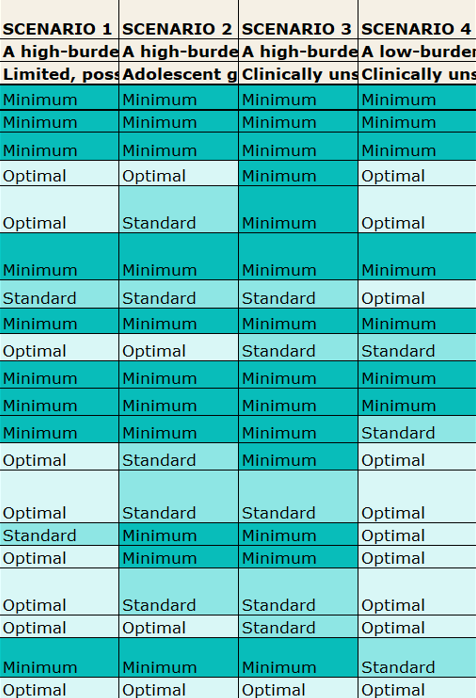
The TIER Tool – Tool for Intervention, Evaluation and Ranking (IAS) (Version 30 July 2025)
This tool offers a structured framework for prioritizing components of an HIV programme, including HIV treatment and care (continuity, monitoring, initiation and re-initiation), testing and prevention. It incorporates adaptable prioritization criteria according to the epidemiological context and progress toward the 95-95-95 targets.
French – Lʼoutil TIER dʼévaluation et de classement des interventions (IAS) (Version 30 juillet 2025)
Spanish – La herramienta de evaluación y clasificación de intervenciones (TIER) (IAS) (Versión del 30 de julio de 2025)
Portuguese – TIER – Ferramenta de Avaliação e Classificação de Intervenções (IAS) (Versão de 30 de julho de 2025)
Discussions and planning for sustainability of HIV programming have been ongoing for several years prior to the 2025 shift in donor funding. A number of tools have been developed to guide countries in developing a country specific plan. This section provides links to tools developed by UNAIDs and country examples of initial sustainability plans.
3.1 UNAIDS sustainability tools
More information on the Rapid AIDs Response Financing Tool
This tool is designed to help countries quantify the impact of changes in PEPFAR funding and take immediate financial and programmatic actions to sustain essential HIV services. It does not assess the implications of implementing tiered service packages based on available funding sources.
More information on the UNAIDS HIV Response Sustainability Primer
The Primer provides a strategic framework for planning and implementing sustainable national HIV responses. It aims to mobilize efforts toward long-term sustainability and to support countries in reaching and maintaining epidemic control beyond 2030. Grounded in country-led processes and informed by the latest data, the Primer guides countries in developing HIV Response Sustainability Roadmaps. These Roadmaps focus on high-level outcomes across key sustainability domains:
- Political leadership
- Equitable access to quality services
- Strengthened health system capacity
- Enabling policy environments
- Sustainable domestic and international financing
More information on the UNAIDS HIV Response Sustainability Roadmap: Part A Companion Guide
The Companion Guide is designed to support countries in the initial development of their HIV Response Sustainability Roadmaps. It complements the Primer by offering a practical, flexible, and adaptable methodology that countries can tailor to their specific contexts. The approach is holistic, addressing the programmatic, political, structural, and financial dimensions of sustainability.
Countries may choose to undertake a broader, integrated planning process that includes other diseases or health systems components from the outset. This flexibility is built into the methodology, allowing countries to align the Sustainability Framework and Roadmap components with existing national strategies and priorities.
Progress to date – As of the end of March 2025, 13 countries have formally endorsed their Part A Sustainability Roadmaps, with an additional eight countries in the process of finalizing draft versions.
Country examples Part A Sustainability Roadmaps (UPCOMING)
UPCOMING – UNAIDS HIV Response Sustainability Roadmap: Part B Companion Guide
UNAIDS, upcoming
More information on the UNAIDS HIV Response Sustainability Roadmap: Part B Companion Guide
Part B of the HIV Response Sustainability Roadmap provides practical resources to support the detailed planning and implementation of the national sustainability roadmap. It includes tools and guidance for developing a comprehensive transformation plan, encompassing:
- Key strategic priorities
- Estimated costs
- Monitoring and evaluation (M&E) plan
- Quality management plan
- Defined timelines and responsibilities
- Risk mitigation strategies
In addition, Part B outlines how countries can approach monitoring and oversight of the Roadmap, including the collection and use of programme data, and implementing quality assurance and quality improvement mechanisms.
Given the current landscape of significant funding changes and reductions, the guide emphasizes the importance of regular review and updating of the Roadmap to ensure it remains responsive, effective, and aligned with evolving programmatic and financial realities.
More information on the Country Profiles: Sustainability Data Snap Shot
The HIV Analytics for Sustainability Planning Country Profiles offer a concise overview of critical indicators related to a country’s HIV response. Each profile includes:
- Key characteristics of the national HIV epidemic
- Fiscal and macroeconomic indicators
- Health system spending metrics
These profiles present data in both tabular and graphic formats to enable quick, accessible insights. The goal is to support evidence-based strategic planning by providing decision-makers with a broad yet focused view of the factors influencing sustainability of the HIV response.
3.2 Political leadership
Key questions
- Is there high-level political commitment to sustaining the HIV response, including in the context of declining donor funding? How is this demonstrated (e.g., policy declarations, budget allocations, cabinet-level leadership)?
- Are national and subnational leaders actively engaged in driving multisectoral and integrated approaches to HIV and broader health systems strengthening?
- Has the country articulated a long-term vision for HIV sustainability, including alignment with universal health coverage (UHC) and primary health care goals?
- Are there mechanisms for accountability and transparency in place (e.g., parliamentary oversight, public reporting, community engagement) to ensure leadership drives effective and equitable HIV services?
- Is political leadership mobilizing domestic resources (public or private) to fill gaps created by reductions in donor support?
- How is interaction with the private sector being coordinated and has their future role in HIV and broader health response been defined?
3.3 Enabling laws and policies
Key questions
- Do current national policies support the decentralization of care, including task-sharing for chronic disease management to primary care and nurse-led service delivery models?
- Do pharmacy regulations permit lower cadres of healthcare workers at the primary care level to prescribe and dispense HIV and other chronic disease medications required for initiation and ongoing management?
- Do operational policies enable differentiated service delivery, such as less intensive clinical follow-up and longer medication refill durations across chronic disease areas?
- How are national health insurance schemes adapting in response to shifts in external funding? Should HIV medicines, diagnostics, and related services be included within national health benefit packages?
- Do laws safeguard against discrimination in healthcare settings and employment?
- How supportive are current regulatory frameworks in enabling the use of digital health technologies for monitoring, reporting, and patient engagement in HIV and chronic disease care?
- Are there legal or policy barriers that limit community-led monitoring, advocacy, or involvement in HIV and health system governance?
3.4 Sustainable and equitable financing
Key questions
- What proportion of the national HIV response budget is funded domestically versus by donors, and how is this changing over time?
- Are there strategies or targets in place to increase domestic resource mobilization for HIV services, including innovative financing mechanisms?
- How equitably are HIV resources allocated across populations and geographic areas, particularly to key and vulnerable populations?
- How equitably are health resources allocated across different disease areas and populations?
- Are financial risk protection mechanisms, such as national health insurance schemes, adequately covering HIV prevention, treatment, and care services?
- How are funding gaps being identified and addressed to ensure uninterrupted access to essential HIV services during donor transitions?