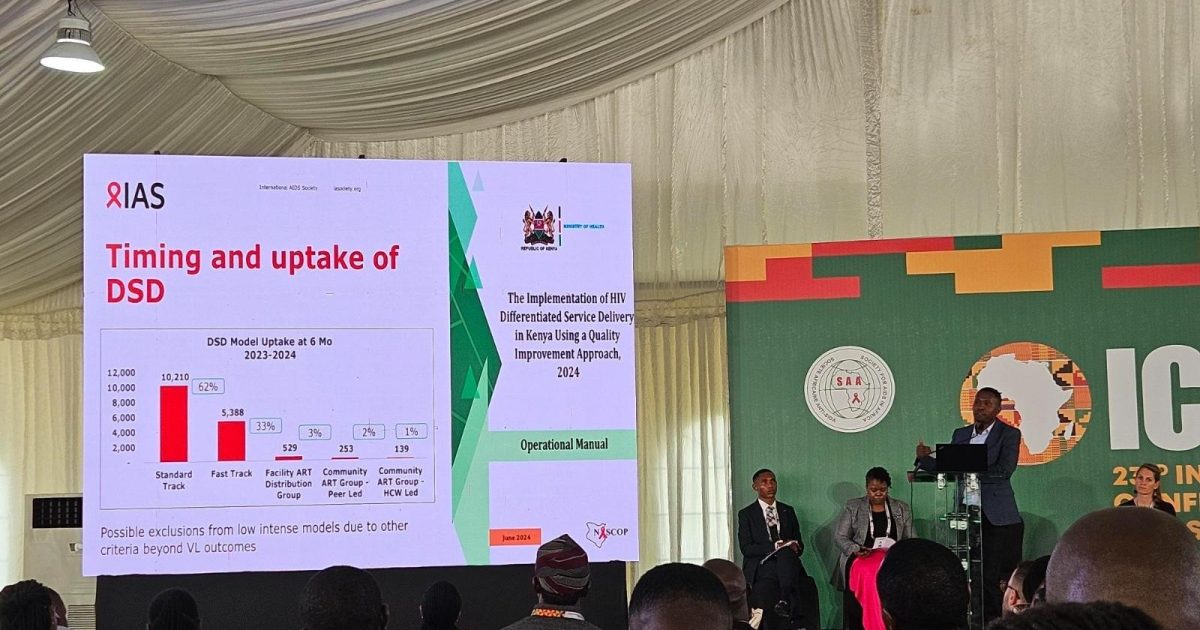
The DSD programme of IAS – the International AIDS Society – organized two consecutive satellite sessions at the 23rd International Conference on AIDS and STIs in Africa (ICASA), held from 3-8 December in Accra, Ghana.
“The Future of Differentiated HIV Services. Part 1 – Prioritize for impact”
Wednesday, 3 December 2025
12:45 PM – 1:30 PM, local time
Location: Dr. Meskerem Bekele Grunitzky Room
Details
As HIV programmes grapple with sharp funding declines, the question is no longer whether to prioritize, but how to do so strategically. This first part of the satellite explored how national programmes are making difficult choices in constrained environments – protecting core services while also seizing opportunities for efficiency and impact. Speakers highlighted the role of differentiated service delivery (DSD) in these processes and the potential to shift the timing of the first viral load after treatment initiation to enable earlier entry into DSD for those doing well and faster support for those who are not. The frequency of facility visits in the first year on ART places significant burdens both on clients and the health system. This is session was followed by a second satellite, “Making care easier and more efficient”. Together, the two satellites provided a cohesive narrative: how to respond to the immediate funding crisis through smarter prioritization and gaining efficiencies for clients and the health system.
Overview of the TIER tool, Lina Golob, IAS, Switzerland
The Malawi experience of prioritizing HIV services, Stephen Macheso, Ministry of Health, Malawi
The evidence and benefits of earlier first viral load monitoring, Lynne Wilkinson, IAS, South Africa
The impact of early viral load: Data from Kenya, Lazarus Momanyi, NASCOP, Kenya
“The Future of Differentiated HIV Services. Part 2 – Making care easier and more efficient”
Wednesday, 3 December 2025
1:45 PM – 2:30 PM, local time
Location: Dr. Meskerem Bekele Grunitzky Room
Details
Building on the prioritization lens, the second part of “The future of differentiated HIV services” focused on service delivery efficiencies achievable through DSD integration and simplification. For women living with HIV using contraception, providing contraception and ART refills in the same DSD models, leveraging increasing self-care contraception options can improve client experience, and optimize scarce resources. At the same time, shifting from six-monthly to annual clinical visits for virally suppressed clients offers a further opportunity to reduce unnecessary system burden safely. Together, these approaches demonstrate how DSD can be leveraged not only to preserve progress but also to transform service delivery. The discussion emphasized lessons learned from countries already advancing integration and simplification and explored how these efficiencies can be institutionalized into national policy and practice. This session was preceded by the satellite, “Prioritize for impact”. Together, the two satellites provided a cohesive narrative: how to respond to the immediate funding crisis through smarter prioritization and earlier viral load testing, while simultaneously charting a sustainable path forward through integration and annual clinical visits.